
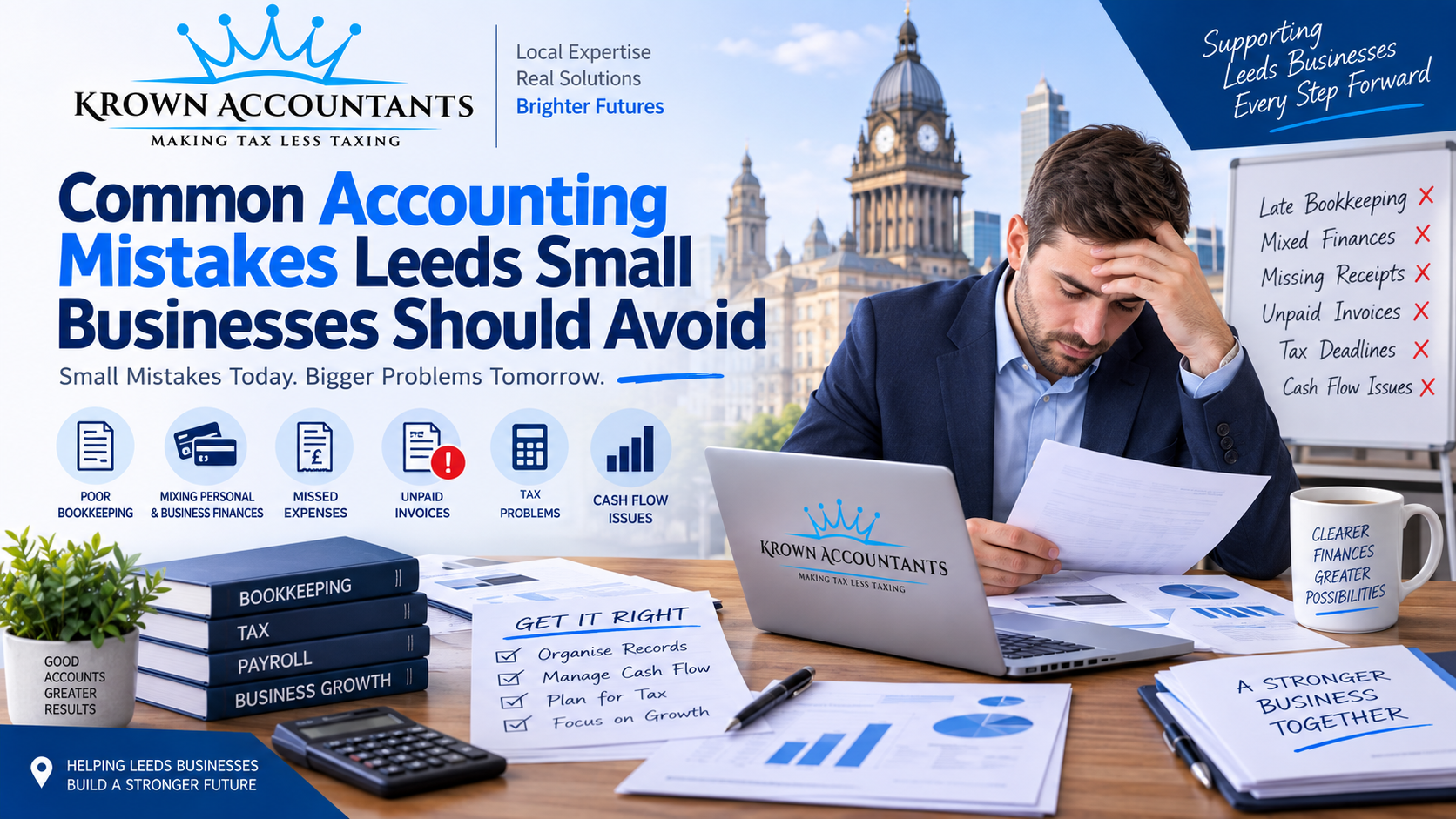
Running a small business in Leeds means managing customers, sales, employees, suppliers and day-to-day operations. With so many responsibilities, accounting can sometimes be pushed to the side.
However, small accounting mistakes can create unnecessary administration and make it harder to understand your business finances. Keeping accurate records and reviewing your financial information regularly can help you stay organised throughout the year.
In this guide, we look at some common accounting mistakes Leeds small businesses should avoid and practical ways to improve financial management.
Why Good Accounting Matters for Small Businesses
Accounting is not just about preparing annual accounts. Your financial records can help you understand your income, expenses, cash flow and overall business performance.
Accurate records can also make it easier to prepare information for tax and other financial responsibilities.
Krown Accountants provides accounting, bookkeeping, payroll, tax and cloud accounting services for businesses and professionals.
1. Leaving Bookkeeping Until the Last Minute
One of the most common mistakes is allowing financial records to build up.
When transactions are recorded weeks or months later, it can become harder to remember what individual payments were for and identify missing information.
A better approach is to establish a regular bookkeeping routine.
This can include:
- Recording income regularly
- Recording business expenses
- Checking bank transactions
- Organising invoices
- Reviewing outstanding payments
- Keeping supporting financial records
Krown Accountants provides bookkeeping support for businesses that need help maintaining organised financial records.
2. Mixing Business and Personal Finances
Using business funds for personal purchases, or personal funds for business expenses, can make accounting more complicated.
Keeping business and personal finances separate makes it easier to identify genuine business transactions and maintain clearer records.
For a small business, consider using:
- A dedicated business bank account
- Separate business payment methods
- A consistent expense-recording process
- Clearly organised receipts and invoices
If you are unsure how a particular transaction should be treated, ask an accounting professional rather than making assumptions.
3. Not Keeping Track of Business Expenses
Small expenses can easily be forgotten.
Software subscriptions, marketing costs, professional services, travel, equipment and other operating expenses can add up over time.
Businesses should maintain appropriate records of their expenses and supporting documents.
Regular expense reviews can also help you understand where your business money is going.
4. Ignoring Unpaid Invoices
A business can make sales but still experience cash-flow pressure if customers do not pay invoices on time.
Regularly reviewing outstanding invoices can help you understand:
- Which invoices remain unpaid
- How long they have been outstanding
- Which payments are expected
- How outstanding amounts may affect cash flow
Your bookkeeping records can provide useful information when reviewing customer payments.
5. Treating Tax as a Year-End Task
Waiting until a deadline is approaching before thinking about tax can create unnecessary pressure.
Tax responsibilities can depend on your business structure, income, expenses and activities.
Krown Accountants provides tax services covering areas including VAT, Self-Assessment, corporate tax, capital gains and other tax-related matters.
Keeping financial records organised throughout the year can make tax-related preparation more manageable.
6. Not Reviewing Cash Flow
Profit and cash flow are not exactly the same thing.
A business may have recorded sales but still have money tied up in unpaid invoices while upcoming expenses, payroll or tax payments need to be paid.
Regular cash-flow reviews can help you monitor:
- Money coming into the business
- Outstanding customer payments
- Supplier payments
- Payroll commitments
- Regular operating expenses
- Upcoming tax liabilities
Understanding these figures can help you plan ahead.
7. Doing Everything Manually When Technology Could Help
Another common issue is relying heavily on spreadsheets or paper records when suitable accounting software could make financial administration easier.
Cloud accounting can provide a digital way to organise financial information and collaborate with an accountant.
Krown Accountants provides cloud accounting support and works with platforms including QuickBooks and Xero.
The right software depends on your business and its accounting requirements.
8. Forgetting About Payroll Responsibilities
Once a small business employs staff, payroll becomes another important financial responsibility.
Payroll administration can involve employee pay, PAYE, statutory payments, pension requirements and related reporting.
If payroll is becoming difficult to manage alongside your other responsibilities, professional payroll support may be worth considering.
Krown Accountants offers payroll services as part of its business accounting support.
9. Not Reviewing Financial Performance
Some business owners only look closely at their finances when preparing annual accounts.
Regular financial reviews can provide a much clearer picture.
Consider reviewing:
- Revenue
- Expenses
- Profitability
- Outstanding invoices
- Cash flow
- Payroll costs
- Tax liabilities
This information can help you understand what is happening in the business throughout the year.
10. Trying to Handle Everything Alone
When a business is new, owners often handle most tasks themselves.
As the business grows, however, financial administration can become increasingly time-consuming.
Professional support may be useful if:
- Bookkeeping takes too much time
- Your number of transactions has increased
- You employ staff
- Your tax responsibilities have become more complicated
- You need regular financial reports
- You want to spend more time running the business
The level of support should depend on your actual business requirements.
How to Avoid Accounting Problems
A few simple habits can make financial administration easier.
Keep Records Updated
Don’t allow transactions to build up for months.
Separate Business and Personal Spending
Use appropriate accounts and payment methods for business activity.
Review Invoices Regularly
Know which customers have paid and which invoices remain outstanding.
Monitor Expenses
Review recurring and one-off costs regularly.
Plan for Tax
Keep tax-related financial information organised throughout the year.
Use Suitable Accounting Software
Digital accounting can help organise records and make collaboration easier.
Get Professional Help When Needed
If accounting responsibilities are becoming difficult to manage, professional support can provide a practical solution.
Accounting Support for Different Leeds Businesses
Accounting requirements can vary depending on the type of business.
Retail & E-commerce
Retailers and online sellers may need to manage sales, purchases, stock-related information and operating expenses.
Krown provides dedicated support for Retail & E-commerce businesses.
Real Estate & Construction
Construction and property businesses can have project costs, suppliers and other financial transactions that require organised accounting.
Healthcare Professionals
Doctors and other healthcare professionals may have specific accounting requirements depending on their work and income structure.
Travel & Tourism
Travel agencies and tourism businesses may also have sector-specific accounting requirements.
Krown currently lists healthcare, real estate and construction, retail and e-commerce, travel and tourism, charities and hospitality among the industries it supports.
When Should a Leeds Business Consider Professional Accounting Support?
There is no single answer for every business.
However, professional accounting support may be useful when your business:
- Has increasing transaction volumes
- Employs staff
- Has VAT responsibilities
- Needs regular financial reporting
- Is experiencing cash-flow challenges
- Is expanding
- Has complicated tax requirements
- Needs help with bookkeeping
- Wants to move to cloud accounting
The important thing is to choose a level of support that fits your business.
Frequently Asked Questions
1. What are the most common accounting mistakes small businesses make?
Common issues include delaying bookkeeping, mixing business and personal finances, losing expense records, ignoring unpaid invoices and leaving tax-related preparation until the last minute.
Regular financial reviews and organised record keeping can help reduce these problems.
2. How often should a Leeds business update its bookkeeping?
The appropriate frequency depends on the size and activity of the business.
A business with many daily transactions may need frequent updates, while a smaller business may have fewer transactions.
The important thing is to avoid allowing records to become significantly out of date.
3. Can accounting mistakes affect cash flow?
Yes. Missing invoices, unrecorded expenses and poor visibility over upcoming payments can make it harder to understand your available cash.
Regular bookkeeping and cash-flow reviews can provide better visibility of the business’s financial position.
4. Should small businesses use accounting software?
Accounting software can be useful for many small businesses.
Cloud accounting can help businesses organise financial information digitally and share relevant records with their accountant. Krown provides cloud accounting support using platforms such as QuickBooks and Xero.
The most appropriate software depends on the business’s requirements.
5. When should I outsource bookkeeping?
You may want to consider outsourcing bookkeeping when it is taking too much of your time, transactions have increased or your records are becoming difficult to maintain.
Professional bookkeeping can allow business owners to focus more on customers, operations and business development.
6. Can an accountant help with tax planning?
An accountant can provide professional guidance on tax-related matters and help businesses organise the financial information required for tax work.
Krown Accountants provides tax services for businesses and professionals.
The appropriate tax approach depends on your individual circumstances.
7. Why is separating business and personal finances important?
Keeping business and personal transactions separate makes it easier to identify business activity and maintain clearer financial records.
It can also make bookkeeping and financial reporting more straightforward.
8. Can an accountant help with payroll?
Yes. Accountants can provide payroll services for businesses that employ staff.
Depending on the service, this can include payroll processing and related administrative and reporting requirements.
9. How can a Leeds accountant help a growing business?
An accountant can support areas such as bookkeeping, accounts, tax, payroll, financial reporting and cloud accounting.
As a business grows, professional support can help maintain organised financial processes while the owner focuses on running the business.
10. How can I avoid accounting problems as my business grows?
Keep your records updated, separate business and personal finances, review cash flow, monitor expenses, prepare for tax responsibilities and use suitable accounting systems.
If financial administration becomes difficult to manage, consider getting professional accounting support.
Final Thoughts
Good accounting starts with consistent habits.
For small businesses in Leeds, keeping financial records updated, monitoring expenses, reviewing invoices and planning for tax can make everyday financial management much easier.
As your business grows, you may also benefit from bookkeeping, payroll, tax, accounting or cloud accounting support.
Krown Accountants provides a range of accounting services for businesses and professionals, including bookkeeping, tax, payroll and cloud accounting.
If your business needs professional accounting support, you can contact Krown Accountants to discuss your requirements.